
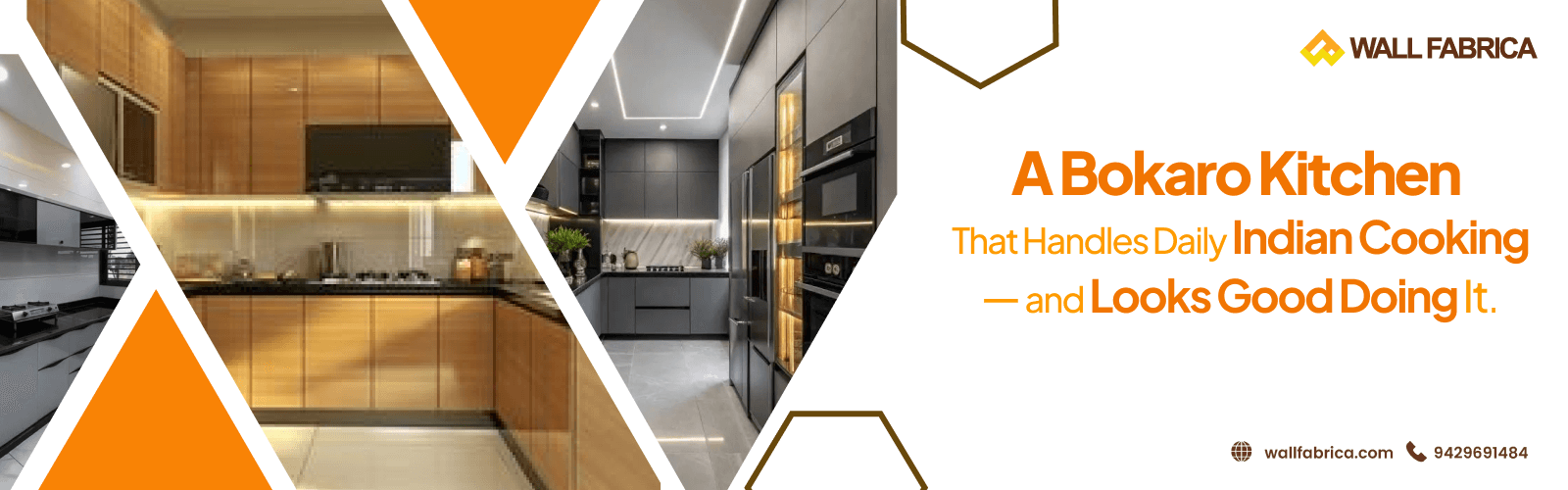
The kitchen is the room that makes or breaks a home interior. It is where daily life is most
concentrated — breakfast, cooking, family conversations, hosting — and it is the room that most
directly affects the resale or rental value of any property in Bokaro Steel City.
A well-designed kitchen in a Bokaro home does three things simultaneously: it works efficiently
for how your family actually cooks, it holds up under the specific conditions of Indian cooking —
high heat, oil splatter, steam, hard water — and it looks good enough that you want to spend
time in it.
Wall Fabrica handles kitchen interior design and execution in Bokaro Steel City, Chas,
Dhanbad, and Ranchi. This guide covers everything you need to plan your kitchen project —
layouts, materials, wall panels, ceiling options, and what a well-executed Bokaro kitchen
actually costs.
Every room in a home has design requirements. The kitchen has more than any other — and
getting them wrong creates problems that compound over years rather than resolving
themselves.
Indian cooking conditions are punishing on surfaces. A Bokaro kitchen that handles daily
dal, sabzi, rotis, and occasional deep frying generates sustained high heat, oil aerosol, and
steam that degrades surfaces faster than any equivalent in European or American kitchen
design. Materials that last 10 years in a lightly used kitchen last 3 years in an actively used
Indian one. Every material choice in a Bokaro kitchen must be evaluated against this reality.
Hard water accelerates surface degradation. Bokaro's water supply — in common with much
of Jharkhand — is hard to very hard, with high mineral content. This leaves white calcium
deposits on any surface that gets wet regularly: countertops, sink areas, backsplash tiles, tap
fixtures. Material choices for anything near water must account for hard-water marking and
cleaning frequency.
Ventilation is frequently inadequate in Bokaro township apartments. Many kitchens in
Bokaro's older residential sectors — particularly Sector 4 and Sector 9 township apartments —
have internal ventilation only: a window or shaft that does not provide adequate exhaust for
active cooking. A kitchen design for these apartments must include a properly positioned
exhaust fan and, where possible, a chimney — both of which affect ceiling design and wall
panel placement.
Kitchen quality directly affects property value. In Bokaro's residential property market, a
well-designed and well-maintained modular kitchen is the single most significant interior factor in
property valuation. Homes with outdated, damaged, or poorly functioning kitchens consistently
sell and rent for less than comparable properties with modern, functional kitchen interiors.
Kitchen investment has the highest return on investment of any interior room — which is why it
deserves proportionally more design attention.
Layout is the first decision in any kitchen design — before materials, colours, or appliances. The
right layout depends on the kitchen's dimensions and the cooking habits of the household.
| Layout Type | Best For | Key Advantage in Bokaro Homes |
|---|
| Straight / Single Wall | Small kitchens under 60 sq ft, studio apartments | Maximises limited floor space. Works well in older Bokaro township apartments with narrow kitchen dimensions |
| L-Shaped | Medium kitchens (60–100 sq ft), common in 2BHK and 3BHK | Creates a natural work triangle between hob, sink, and storage. Allows a breakfast counter on the open end |
| U-Shaped | Larger kitchens (100 sq ft and above), 3BHK, villas, independent houses | Maximum storage and counter space. Ideal for households that cook frequently and need appliance space |
| Parallel / Galley | Narrow kitchens where two walls are available | Efficient workflow. Common in Bokaro's older apartment stock with long, narrow kitchens |
| Island Kitchen | Open-plan homes, villas, premium apartments with 150+ sq ft kitchen | Premium look and excellent functionality. Increasingly popular in Chas and New Bokaro new-build homes |
Most Bokaro apartments in the residential sectors fall into L-shaped or parallel layouts. The
layout determines where wall panels can be placed, where the false ceiling design has most
impact, and where lighting needs to be most precisely positioned.
The wall behind the hob and the wall behind the sink are the two surfaces in any kitchen that
face the most aggressive daily conditions. Getting these right is more important than any other
single design decision in the kitchen.
The Splashback Wall — Behind the Hob
The hob splashback is exposed to oil splatter at high temperature, direct heat from cooking
flame or induction, and steam from boiling. This is the harshest surface environment in any
home.
• Best choice for Bokaro kitchens: Solid-core PVC panels with a smooth, non-textured
surface. No grout joints, no tile spacing, no surface texture that traps oil. A smooth PVC
surface is wiped clean with a kitchen degreaser in under 10 seconds — an outcome that
ceramic tile with cement grout cannot match after 18 months of regular Indian cooking
use.
• Second choice: Large-format glazed ceramic tile (minimum 60x60cm) with epoxy grout.
Fewer grout joints than small tiles, and epoxy grout resists oil staining significantly better
than cement grout. Requires a skilled tiler to lay large format correctly — common
mistake in Bokaro is laying large format with an inexperienced tiler, creating lippage
(tiles not perfectly level) that looks poor and is difficult to clean.
• Avoid: Small ceramic tiles (20x20 or 30x30) with cement grout behind a hob. The grout
joints accumulate oil, turn brown within 6 months of regular cooking use, and are
impossible to restore to their original colour regardless of cleaning effort.
The Sink Wall — Moisture and Hard Water Zone
The wall above and around the sink faces sustained moisture exposure and hard water mineral
deposits. Calcium scale from Bokaro's hard water builds up on any surface that gets regularly
wet.
• Best choice: Stone-effect PVC panels. The smooth, non-porous surface prevents
calcium deposits from bonding into the surface — they sit on top and wipe off with a mild
acid cleaner (diluted vinegar or commercial descaler). This is significantly easier to
maintain than grouted tile in a hard-water area.
• Practical note: Install a water softener or in-line descaler on the kitchen tap inlet if hard
water marking is a persistent problem in your Bokaro home. This is the single most
impactful maintenance decision for any kitchen sink area, regardless of wall material.
Upper Cabinet Walls and Remaining Kitchen Walls
The walls between and above upper cabinets, and the walls on the non-cooking sides of the
kitchen, face moderate conditions: occasional cooking vapour, general kitchen humidity, and
cleaning with household sprays.
• Most practical choice: Smooth matte-finish PVC wall panels across all remaining
kitchen walls. Consistent material across the full kitchen creates a cleaner, more unified
appearance than mixing panels on some walls and paint on others. Maintenance is
uniform — the same wipe-down routine across all surfaces.
• Design consideration: If the kitchen is open-plan or has a serving window into the
dining or living area, the visible wall surface should be treated to the same standard as
the main kitchen panels — not left as painted plaster, which creates a jarring material
change at the visual transition.

The kitchen ceiling is subjected to conditions that no other room ceiling faces: sustained heat,
cooking vapour, grease aerosol, and steam. The ceiling material choice must account for all of
these.
The only appropriate ceiling material for an active Indian kitchen: PVC plank ceiling. Fully
waterproof, grease-resistant, wipe-clean. No gypsum board in an active cooking kitchen — it
absorbs moisture and grease vapour over time, stains irreversibly, and requires repainting every
2 to 3 years. PVC ceiling in a kitchen requires only a damp cloth and mild degreaser to maintain
indefinitely.
Kitchen Ceiling Design Decisions
• Exhaust fan position: The exhaust fan should be positioned directly above or
immediately adjacent to the hob — not near the kitchen door or window, where it has
least effect on the actual cooking zone. The ceiling design must accommodate the
exhaust fan cutout at the correct position before installation begins. Post-installation
cutting is messier and creates a less clean joint.
• Chimney vs exhaust fan: A chimney (range hood) is more effective than a ceiling
exhaust fan for active Indian cooking. If a chimney is planned, the ceiling design must
accommodate the chimney duct routing — typically through the ceiling void and out
through an external wall. This affects where the false ceiling frame can be positioned
and must be coordinated with the kitchen layout before any ceiling work begins.
• Lighting above the counter: Under-cabinet lighting (LED strips mounted to the
underside of upper cabinets) and a recessed downlight directly above the hob are the
two most functional kitchen lighting additions. Both should be planned as part of the
kitchen design, not added afterwards — the electrical conduit routing for under-cabinet
lights runs behind wall panels and above the ceiling, and must be installed before
surfaces are closed.
• Ceiling height consideration: Most Bokaro apartments have finished ceiling heights
between 9 and 10 feet. A PVC false ceiling in the kitchen drops this by 6 to 10 inches
depending on the frame depth. In kitchens with a chimney, allow additional vertical
clearance between the countertop and the ceiling — minimum 650mm between the hob
surface and the bottom of the chimney hood.
Modular kitchen pricing in Bokaro ranges enormously depending on material grade, layout size,
and appliance selection. Here is a framework that reflects Bokaro's actual market:
| Component | Budget Range (Bokaro) | What Drives the Variation |
|---|---|---|
| Base cabinets (per running foot) | Rs. 1,800 – 4,500 | Board type (commercial MR vs BWR vs marine plywood), shutter finish (foil vs acrylic vs lacquer) |
| Wall / upper cabinets (per running foot) | Rs. 1,200 – 3,200 | Same board and shutter grade as base cabinets. Height of upper cabinet affects material quantity |
| Countertop (per running foot) | Rs. 800 – 3,500 | Granite (most durable for Indian cooking) vs engineered stone vs solid surface |
| Splashback PVC panels (per sq ft, supply + install) | Rs. 75 – 150 | Panel grade, finish type, whether overlay is done on existing surface |
| Kitchen PVC false ceiling (per sq ft) | Rs. 60 – 100 | Panel type, frame quality, exhaust cutout, recessed light cutouts |
| Sink and tap (supply only) | Rs. 4,500 – 22,000 | Stainless steel grade, sink size, tap brand and finish |
| Chimney / exhaust fan (supply only) | Rs. 6,000 – 35,000 | Chimney vs fan, suction power, filter type, brand |
| Hob (supply only) | Rs. 4,000 – 25,000 | Gas vs induction, number of burners, brand |
For a full modular kitchen in a typical Bokaro 2BHK apartment — L-shaped layout,
approximately 8 feet of base cabinets and 8 feet of upper cabinets, granite countertop, PVC
splashback, PVC ceiling, standard appliances:
• Budget kitchen (functional, MR board, foil shutters): Rs. 1,10,000 – 1,60,000
complete.
• Mid-range kitchen (BWR board, acrylic shutters, granite, chimney): Rs. 1,80,000 –
2,80,000 complete.
• Premium kitchen (marine ply, lacquered shutters, engineered stone, premium
appliances): Rs. 3,00,000 – 5,00,000 complete.
These ranges include all cabinets, countertop, wall panels, ceiling, sink and tap, and basic
appliances. Electrical work (additional power points, circuit protection) is quoted separately
based on your existing wiring condition.
Kitchen projects are the most complex interior scope we handle — more moving parts, more
trade coordination, and more decisions that affect each other than any other room. Our
approach reflects this.
1. Site visit and measurement — we measure every wall, note every existing electrical
point, assess ventilation and plumbing positions, and photograph the current kitchen
before discussing any design direction.
2. Layout design — we prepare an accurate layout drawing showing cabinet positions,
countertop zones, appliance placement, and the relationship between the kitchen and
adjacent dining or living areas.
3. Material specification — every material is named: board brand and grade, shutter type
and finish, countertop material and thickness, panel brand for splashback, ceiling panel
type. No vague descriptions.
4. Coordinated execution — our team manages cabinets, wall panels, ceiling, electrical
coordination, and plumbing connections under one project plan. You do not manage
multiple vendors simultaneously.
5. Handover and support — we walk through the completed kitchen with you, test all
mechanisms (drawers, hinges, soft-close, chimney), and provide a support period for
any post-handover adjustments.
Book a Free Kitchen Site Visit — Bokaro Steel City Tell us your kitchen size and cooking style.
We visit your home, measure the space, and give you a material-specific proposal with a fixed
price — not a vague estimate. Serving: Sector 4 | Sector 9 | City Centre | Chas | Dhanbad |
Ranchi Wall Fabrica | Kitchen & Full Interior Design | Bokaro Steel City, Jharkhand