
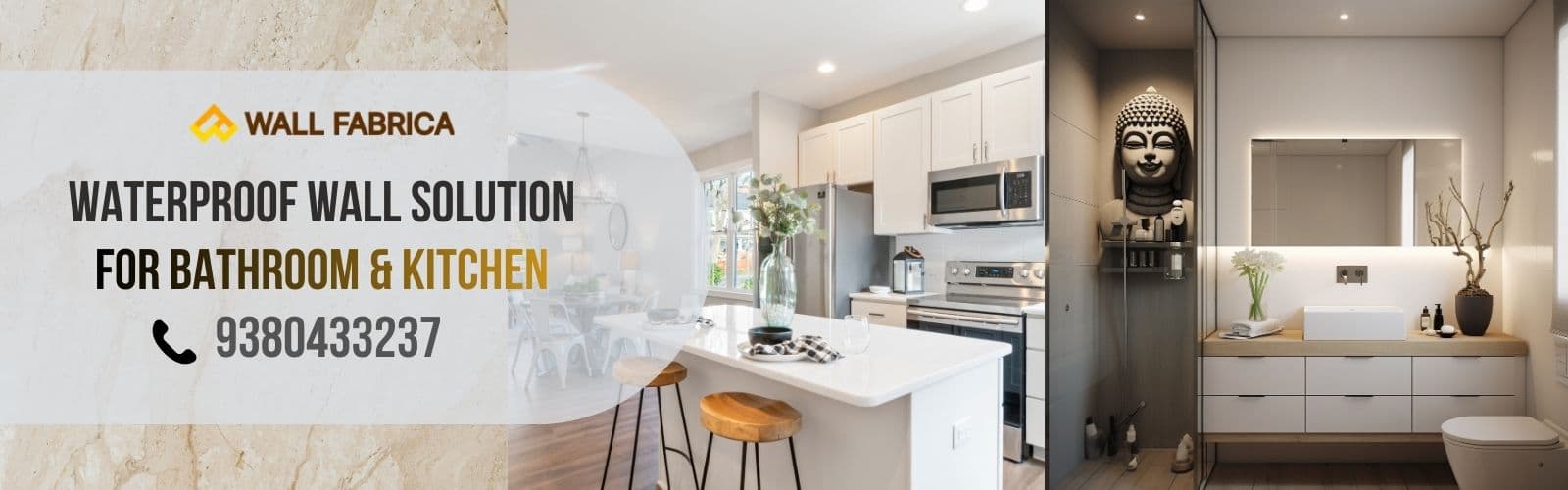
Bathrooms and kitchens are two of the hardest-working spaces in an Indian home.
One deals with regular water exposure. The other has to handle cooking, oil, steam, splashes and heat. That makes the wall finish more important than it may seem when planning an interior.
For homeowners in Bangalore, Ranchi and Bokaro, the goal is not simply to find a wall surface that looks good on installation day. It is to choose a material that fits the way the space is actually used.
This is where PVC wall panels can be a practical option.
According to Architectural Digest India, PVC panels are waterproof and particularly suitable for moisture-laden areas such as kitchens and bathrooms. The publication also notes that their non-porous surface does not promote mould or mildew growth and that they are available in different colours and 3D finishes.
But choosing a waterproof wall solution is not simply about putting the same material everywhere.
The location, heat exposure, design and installation all matter.
Water and moisture can be hard on conventional wall finishes.
Depending on the material, repeated exposure can contribute to:
This is why the wall finish in a bathroom or kitchen should be selected differently from a bedroom or living room.
For example, Architectural Digest India points out that materials such as MDF should not be used on damp walls because moisture can cause the material to swell and deteriorate.
PVC takes a different approach.
Its non-porous, waterproof surface makes it particularly useful where regular moisture is part of everyday life.
PVC panels are made from polyvinyl chloride and are commonly used as decorative wall and ceiling surfaces.
Their biggest advantage in wet areas is straightforward:
Water does not behave with PVC the same way it does with absorbent wall materials.
That makes PVC panels useful for spaces such as:
Architectural Digest India also describes PVC panels as easy to install and hygienic, making them attractive when both functionality and appearance matter.
The result is a wall surface that can combine practical performance with decorative design.
The bathroom is perhaps the most obvious place to consider a waterproof wall finish.
Every day, the walls may encounter:
PVC panels are well suited to this type of environment because of their waterproof and non-porous characteristics.
The exact suitability of a panel for a shower or continuously wet area should still be checked against the product's installation specifications.
For a compact bathroom in Bangalore, Ranchi or Bokaro, a carefully selected light-coloured panel can also contribute to a brighter visual appearance.
Architectural Digest India notes that lighter colours can help compact bathrooms feel more spacious, while gloss finishes can reflect light and make the room appear brighter.
This is one area where PVC has a practical advantage.
Because PVC panels have a non-porous surface, Architectural Digest India notes that they do not promote the growth of mould or mildew in the way porous materials can.
That does not mean a bathroom can ignore every moisture-related problem.
If there is:
the underlying problem still needs to be addressed.
A waterproof wall surface can protect the wall finish from ordinary water exposure, but it should not be presented as a solution to a structural water problem.
Kitchen walls have a different challenge.
The problem is not just water.
It is:
A good kitchen wall surface therefore needs to be both practical and easy to maintain.
PVC panels can work well in suitable kitchen areas because their non-porous surface makes everyday cleaning simpler.
But there is one important qualification.
The area immediately behind a gas stove or high-heat cooking zone deserves more careful material selection.
Architectural Digest India's guide to kitchen backsplashes notes that thermoplastic materials can warp or deform when exposed to temperatures above 60°C, and therefore may not be suitable directly behind the stove. It recommends heat-resistant materials such as ceramic, porcelain, glass and metal for that particular application.
So at Wallfabrica, we would approach the kitchen in two zones:
PVC can be a practical decorative option where the product is suitable for the application.
Choose a material specifically designed to withstand the temperatures involved.
Waterproof does not automatically mean heat-proof.
That distinction is important when planning a kitchen.
The choice is not simply about deciding which material is “better”.
It depends on what you value in the space.
Tiles remain a popular choice because they offer:
But grout introduces additional lines that need cleaning.
Architectural Digest India points out that smaller or mosaic tiles can involve more joints and therefore more grout to clean.
PVC panels offer:
So the decision should be based on the room, the exposure and the design objective, rather than treating one material as universally superior.
One of the biggest advantages of a smooth wall surface is the simplicity of everyday cleaning.
PVC is already a low-maintenance material. There is no need to turn routine cleaning into a complicated process.
This is an important distinction homeowners should understand.
A panel can be waterproof and still have application-specific limitations.
Before selecting a PVC panel, consider:
This is especially important in kitchens.
The right question is not:
“Is PVC waterproof?”
It is:
“Is this particular PVC panel suitable for this particular location?”
That approach produces a much better interior.
Waterproof walls do not have to look purely functional.
PVC panels are available in different colours, textures and decorative patterns. Architectural Digest India specifically highlights the availability of PVC panels in multiple colours and 3D designs.
This gives designers room to treat the bathroom or kitchen wall as part of the overall interior rather than simply a surface that needs protection.
For a premium Bangalore apartment, for example, a subtle marble-inspired panel can create continuity with the countertop.
In a Ranchi or Bokaro home, a warmer wood-inspired finish can bring more visual warmth to a compact kitchen or utility area.
The material should support the room rather than dominate it.
Bangalore interiors often benefit from designs that balance natural light, compact layouts and practical everyday use.
The objective is a bathroom or kitchen that feels clean, contemporary and easy to live with.
For Wallfabrica's Jharkhand projects, the same material-selection principles apply.
Think about:
Consider:
There is no need to create an entirely different design language for these locations.
Instead, adapt the material and finish to the specific home and its usage.
A waterproof wall does not have to look like a purely functional decision.
The right wall finish can:
That is where material selection becomes part of interior design rather than simply construction.
And if you are already thinking about colour combinations for the rest of the home, our guide on Best Color Themes for Luxury Interior Designs can help you build a more cohesive palette.
Bathrooms and kitchens need wall finishes that can handle the way Indian homes are actually used.
PVC wall panels can be a practical waterproof solution for suitable applications because they offer a non-porous, easy-to-clean and decorative surface. Architectural Digest India specifically identifies PVC as a suitable material for moisture-laden kitchens and bathrooms.
But good interior planning means knowing where the material should and should not be used.
Use PVC where its waterproof and decorative qualities make sense. Be more careful around direct high-heat cooking zones. Check the specifications of the actual product. And let the design of the room guide the finish.
At Wallfabrica, with Bangalore as our primary focus and Ranchi and Bokaro as important Jharkhand operating zones, we believe waterproof wall solutions should do more than resist water.
They should make the space easier to maintain, easier to design and better suited to everyday Indian living.