
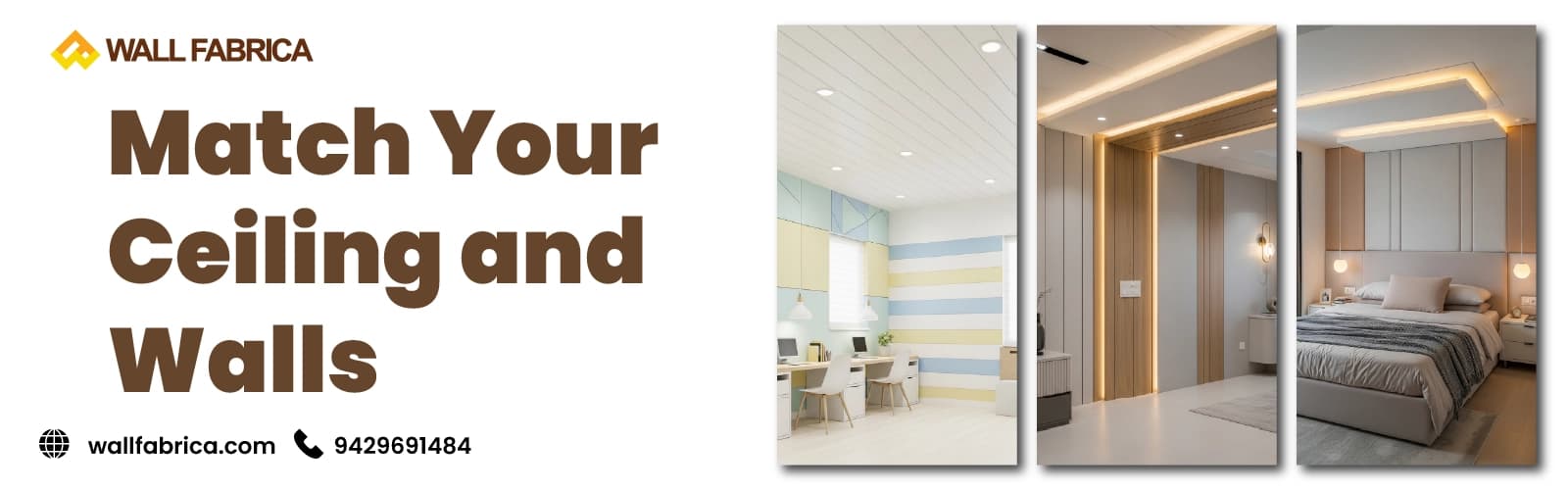
Here's a pattern I notice constantly with new clients: they've picked a gorgeous wall panel, they've picked a stunning ceiling design, and somehow the finished room still feels a little off. Nine times out of ten, the answer is that the two were chosen separately, by two different trains of thought, weeks apart.
A ceiling and a wall aren't two separate decisions. They're one decision made in two parts. Get that right, and a room feels effortless. Get it wrong, and no amount of expensive material fixes the disconnect. Here's how I'd actually pair them.

Sometimes the smartest ceiling is the one you barely notice.
There's a reason this pairing keeps showing up in every warm, "why does this room feel so nice" photo you've saved.
Clients usually notice the difference the very first evening they switch it on — the room just feels warmer, even before winter sets in.
Marble finish is a statement on its own. Don't make it compete with a busy ceiling.
Some rooms are built around an impressive ceiling. In those cases, the walls should support, not compete.
This is the one I reach for when someone specifically asks for a wall that impresses guests the moment they walk in.
I always tell clients: a false ceiling isn't decoration wearing a functional disguise. It actually does something.
That last point alone has saved more than one client from picking a design their ceiling height simply couldn't support.
A bedroom's job is to help you switch off. The design should support that, not fight it.
In the smaller bedrooms and study nooks common across Bokaro and Ranchi apartments, restraint matters even more.
| Ceiling Style | Pairs Best With |
|---|---|
| Plain ceiling | Textured wall panels |
| Cove lighting | Wood-finish panels |
| Layered ceiling | Plain matte panels |
| LED strip ceiling | 3D wall panels |
| Minimal ceiling | Marble-finish panels |
It's real — the air gap between your slab and the false ceiling acts as insulation, which noticeably helps regulate room temperature.
Roughly 8–9 feet is the benchmark most installers work with. Measure first, then get attached to a design.
It's possible, but it rarely turns out as well. The pairings that feel effortless are almost always planned together from day one.
The best-looking rooms I've worked on were never about doing more — they were about letting one surface lead and the other support it quietly. Choose the pairing, keep it simple, and resist the urge to make every surface compete for attention.
If you've found this useful, our piece on kids' room wall panel themes and ideas covers how this same "one surface leads" thinking applies to a child's room specifically. And if you're planning this for a home in Bangalore, Ranchi, or Bokaro, this is exactly the kind of ceiling-and-wall planning Wallfabrica builds in from the very first conversation — not as an afterthought once the walls are already decided.