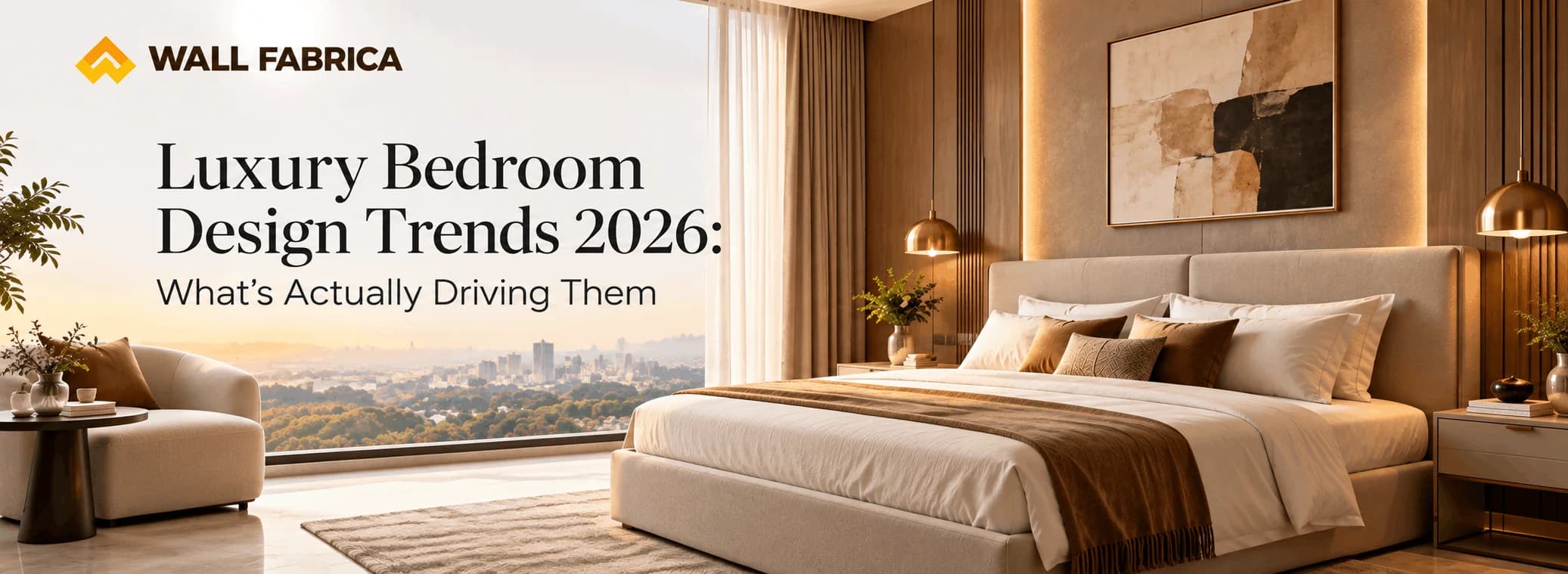
The bedroom has quietly changed and the minimalism of cool greys, crisp lines, furniture that tried to disappear are vanishing.
At Wallfabrica, this is the shift we're seeing across our Bangalore and Jharkhand projects alike. Here are some the trends in 2026 that are shaping the shift.
Cocooning is the idea of designing the bedroom as a deliberate retreat rather than just a room a bed happens to sit in. It shows up as dramatic canopy beds, statement headboards, tactile textures, and palettes that wrap around you instead of bouncing light back at you.
It's a direct reaction to years of "millennial grey" minimalism — rooms that photographed beautifully but never quite felt warm to live in. Domhnall Nolan, Senior Designer at Soho Home, describes it as building "a cosy cave that feels personal and unique." Argent Design founder Fontanella ties it to sleep quality itself, telling Veranda that plush bedding, blackout layers, and warm-dim lighting create genuinely restful recovery zones. What's notable is how consistently this word shows up — Country & Town House, Homes & Gardens, and House Digest have all named it independently as the defining bedroom trend of the year.
Apply it: An upholstered headboard paired with a canopy frame in wood or matte black, plus heavier bed drapery, gets you most of the effect. A full four-poster isn't required.
Clay, terracotta, olive, charcoal, and inky blue—tones feel grounding rather than sterile. Even terracotta itself has softened, moving from the saturated burnt clay of a few years ago into gentler shades like clay pink and chalky adobe.
This isn't just a designer preference—it's backed by the paint industry itself. Two competing giants, Benjamin Moore and Sherwin-Williams, landed on warm-not-cool palettes for their 2026 Colour of the Year picks independently, which rarely happens: Benjamin Moore chose Silhouette AF-655, a deep espresso with charcoal undertones, while Sherwin-Williams picked Universal Khaki SW 6150, a warm mid-tone neutral. Designer Jen Baxter of Baxter Hill Interiors says client requests are moving toward chalky rose, tobacco brown, dusty olive, and soft charcoal.
Apply it: Commit to one warm, grounded hue for the walls or headboard wall, then let charcoal, wood, and brass hardware do the rest of the talking. A whole room in terracotta reads as a costume, not a design choice.
Sharp angles are being replaced by rounded headboards, low platform beds, capsule nightstands, and curved drawer fronts. Beds and case pieces are being treated less like furniture and more like sculpture in the room, and the reasoning is more than visual — curves are believed to reduce visual tension in a space, making it feel calmer to actually sit in. This has moved past editorial styling into real consumer preference: a 2026 industry poll found 47% of respondents preferred curved or irregular furniture silhouettes for their living spaces.
Apply it: One curved anchor piece — the bed frame or headboard — is usually enough. Pair it with a straight-lined wardrobe or bench so the room doesn't lose all structure.
The false ceiling has stopped being decorative trim and become the infrastructure that makes layered lighting possible in the first place — cove lighting, two-level or floating ceilings, linear grooves, wood-panel accents. This is especially strong in Indian residential design: the false ceiling market there is projected to grow from approximately 2,768.57 crore rupees in 2025 to 6,746.62 crore rupees by 2034. Part of the appeal is practical—cove lighting and ceiling detailing can make a small room feel 15–20% larger than it is.
Apply it: If the ceiling height is under 9.5 ft, skip the multi-level structure. A single peripheral cove delivers most of the atmosphere without compressing the room.
Layered lighting means combining ambient, task, and accent sources instead of relying on one overhead fixture — it's the practical backbone that makes every other trend on this list actually function once the sun goes down. It's also the single most-recommended bedroom feature among design professionals, ahead of storage or seating.
Apply it, in order: ambient light first (cove lighting or a ceiling wash), then task light (reading lamps beside the bed, wardrobe interior lighting), then accent light (one warm spotlight on art or a textured wall). If budget allows only one upgrade, put it toward dimmable warm-white LED strips inside the wardrobe.
Pattern is making a comeback, but as a fully coordinated scheme rather than a single printed cushion — bedding, cushions, even loungewear pulled from the same pattern family. It's being called "pattern drenching," a natural follow-up to last year's colour drenching. Canopy structures have given this trend more surface area to actually live on, with pattern running across the canopy, headboard, and wallpapered backdrop instead of competing.
Apply it: Choose one "hero" pattern — usually the bedding or canopy fabric — and repeat a smaller-scale version of it elsewhere, like a piping detail or cushion trim. Repetition reads as layered. Scattering unrelated patterns just reads as clutter.
Matte black hardware — the default modern finish for roughly a decade — is losing ground to warmer, patinated metals, mainly unlacquered and aged brass. The appeal is that brass visibly ages over time instead of staying uniformly flat, which reads as more considered than a uniform matte finish. Most hardware manufacturers now treat matte black as a secondary or accent finish rather than the primary choice across a room.
Apply it: Cap it at two metal finishes per room — brass as the primary, one accent metal (often a blackened tone) reserved for a single statement piece like a faucet or canopy frame. Three or more finishes starts to read as chaotic rather than curated.
Rather than treating the bedroom, wardrobe, and en-suite bathroom as three separate rooms, designers are increasingly planning them as one connected sequence — waking, washing, dressing, leaving — with doors positioned where each step actually begins. As storage and bathing get their own dedicated zones, the headboard wall becomes the single focal point of the sleeping area itself. This shift shows up in the numbers too: homeowners are increasingly pulling extra bathroom square footage from closets and bedrooms rather than adding onto the house.
Apply it: Where space allows, place the closet between the bathroom and the exit rather than directly off the bedroom. You finish dressing on your way out instead of doubling back through a room where someone might still be asleep.
Every trend here is solving the same problem: making the bedroom feel restorative, not just decorated. Warmer colors read as less clinical. Curved furniture reduces visual tension. Layered lighting does the emotional work a single bulb can't. Ceiling architecture, hardware, and suite planning are all quietly in service of the same goal.
The test worth applying to any bedroom choice this year: does it make the room feel like it's holding you, or just decorating around you? If you're planning a bedroom redesign in Bangalore or Jharkhand, the Wallfabrica team can help you figure out which of these actually fit your space.