
A wall panel can look completely different depending on the light falling on it.
A wood texture may look warm and rich under soft lighting but flatter under harsh white light. A 3D panel can appear subtle during the day and become much more dramatic when directional light creates shadows across its surface.
This is why lighting should not be treated as something you decide after choosing the wall panels. The panel and the lighting should be planned together.
The Illuminating Engineering Society (IES) explains that illumination quantity and distribution can influence the appearance of indoor surroundings, including room surfaces, furnishings and objects that are meant to receive visual attention.
In simple terms, good lighting can help your wall texture look the way you intended it to look.
Lighting can affect a wall panel in several ways.
Directional light can create highlights and shadows across grooves, ridges and embossed surfaces.
The colour of a panel is not experienced independently of the light illuminating it. The Illuminating Engineering Society discusses how light sources and their spectral characteristics influence the colour appearance of objects.
A focused beam can draw attention toward a particular wall, artwork, TV area or architectural feature.
Warm and cool light sources can create noticeably different visual environments. The U.S. Department of Energy explains that correlated colour temperature (CCT) describes whether a light source appears warmer or cooler, with warmer light generally appearing more yellowish and cooler light more bluish.
That is why texture + colour + lighting should be considered as one design decision.
| Lighting Type | How It Can Work With Wall Panels |
|---|---|
| Warm LED lighting | Creates a warmer visual atmosphere and complements wood and neutral finishes |
| Spotlights | Directs attention towards selected textures or feature walls |
| Cove lighting | Creates indirect illumination and can add depth around architectural surfaces |
| Wall lights | Adds focused illumination and can create decorative shadows |
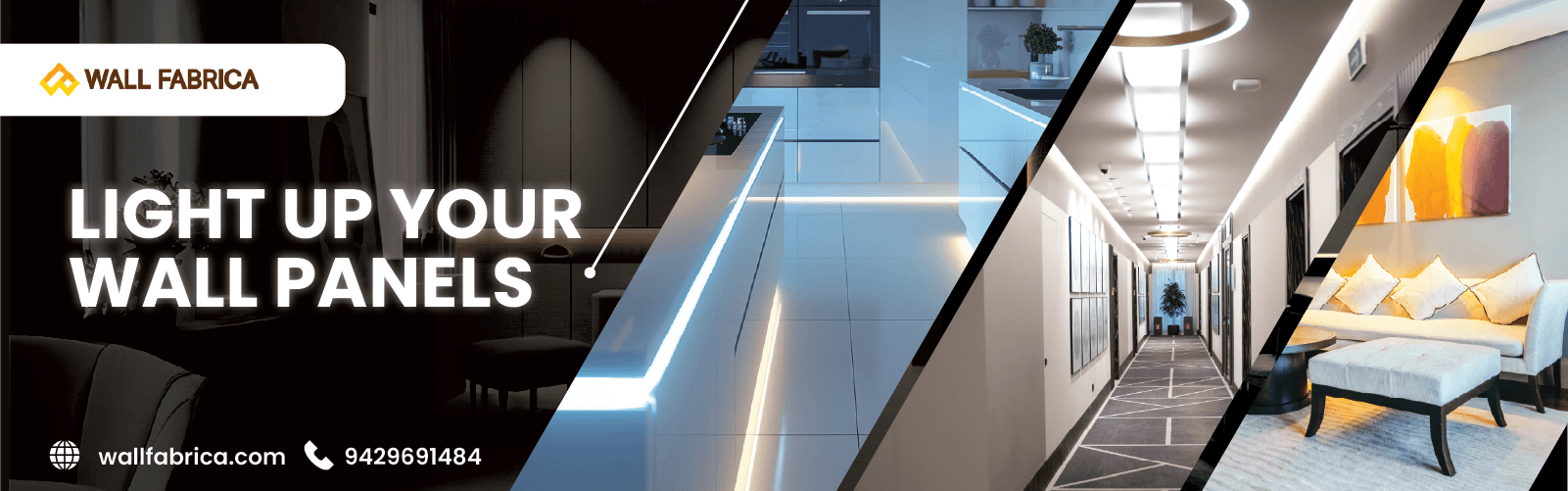
| LED strips | Useful for edges, niches, TV units and contemporary feature walls |
| Natural light | Shows how the panel behaves under changing daylight conditions |
The right combination depends on the panel, room size, ceiling height and the effect you want to create.
Wood-effect and matte panels often work well with warm-toned lighting because the warmer light can complement their earthy appearance.
The U.S. Department of Energy lists around 2,700K as a typical warm light source and around 3,000K as a soft, warm option commonly used in homes.
You can consider warmer lighting around:
The aim is not to make every room yellow. It is to create a lighting temperature that works with the colours and materials already present.
Three-dimensional panels depend heavily on shadows.
When light approaches a textured surface from an angle, the raised and recessed portions of the panel can produce different levels of brightness. This can make the pattern more noticeable than it would be under flat, evenly distributed lighting.
Spotlights can therefore work particularly well on:
But there is a balance to maintain.
Too much direct lighting can make a strong texture appear visually busy. If the panel already has deep grooves, test the lighting position before finalising the installation.
LED strips are useful when you want the light source to remain visually discreet.
Instead of directly illuminating the entire panel, strips can be positioned:
This creates a softer layer of illumination rather than a single bright source.
For marble, stone, wood and matte panels, indirect LED lighting can help create a clean contemporary appearance.
For a festive makeover, the same approach can be adapted with decorative lighting, but it is better to keep permanent lighting design separate from temporary seasonal decoration.
Artificial lighting is only part of the picture.
Daylight changes throughout the day, so a wall panel may look different in the morning, afternoon and evening.
Before finalising a panel, observe:
Light-coloured wood, beige stone and soft matte finishes can create a relatively light visual appearance in daylight, while darker panels may absorb more of the visual emphasis.
This is especially important in rooms where you rely heavily on natural light.
Small rooms do not necessarily need fewer design elements. They need better balance.
A practical approach is to combine:
Avoid placing multiple strong spotlights across a highly textured wall unless you specifically want a dramatic effect.
If the room is already visually busy, softer and more evenly distributed illumination can help maintain balance.
Large rooms often benefit from multiple layers of lighting rather than relying on a single ceiling fixture.
You can combine:
Provides general illumination across the room.
Draws attention to a feature wall, artwork or architectural element.
Adds visual character through pendant lights, wall lamps or other fixtures.
Adds softer illumination around ceilings, niches or furniture.
The IES describes lighting design in terms of both the overall appearance of a space and the way illumination can be directed to provide visual emphasis to selected surfaces and objects.
That principle works particularly well with wall panels: light the room first, then decide what deserves attention.
Not all white light looks the same.
Colour temperature is measured in Kelvin (K), and lower values generally appear warmer while higher values appear cooler. The U.S. Department of Energy's lighting guidance describes approximately 1,800–2,700K as warm in appearance and 4,500–6,500K as cool.
For a residential interior, you might consider:
There is no single Kelvin value that works for every room. The panel colour, furniture, flooring and natural light should all be considered together.
The lighting decision should change depending on the texture.
Try:
Try:
Try:
The objective is to reveal the pattern without creating excessive shadows.
Try:
Try:
The right choice depends on the actual panel sample and the surrounding materials.
A common mistake is to select the light fixture without considering what is around the panel.
Look at:
For example, a dark stone-effect panel with a dark TV unit and very low lighting can make a room feel visually heavy. The same panel with balanced ambient lighting and lighter surrounding elements can create a completely different result.
This is also why material selection matters. If you are deciding between different wall finishes, our guide on PVC vs Gypsum Boards: Which Is Better for Your Home? explains how factors such as moisture exposure, maintenance, finish and room requirements can influence the choice.
One of the simplest ways to avoid disappointment is to test the combination before installing everything.
Take a physical panel sample and observe it:
This can reveal colour shifts, unwanted shadows or excessive glare that may not be obvious from a catalogue image.
It is particularly useful when selecting glossy, marble-effect, dark or heavily textured panels.
Your permanent lighting does not need to change with every season.
Instead, build a flexible lighting foundation and add temporary elements when required.
Consider:
Consider:
The important thing is to avoid covering or overpowering the texture you selected for the wall.
If you are unsure where to start, use this sequence:
Panel texture → Panel colour → Natural light → Ambient lighting → Accent lighting → Final testing
This prevents the common mistake of choosing the panel first and trying to force the lighting to work afterward.
A wall panel does not exist in isolation.
Its colour, texture and finish are constantly being interpreted through the light around it. A subtle texture can become more expressive with directional illumination, while a dramatic 3D surface may need softer lighting to keep the room balanced.
So when planning your next interior makeover, don't ask only:
"Which wall panel should I choose?"
Also ask:
"How do I want this wall to look at 10 AM, 6 PM and 10 PM?"
That small shift in thinking can lead to a much more considered interior.
At Wallfabrica, wall panels should be treated as part of the complete interior rather than as an isolated wall covering. When the material, texture, colour and lighting are planned together, the finished space feels more cohesive—and the wall gets the opportunity to look its best throughout the day.